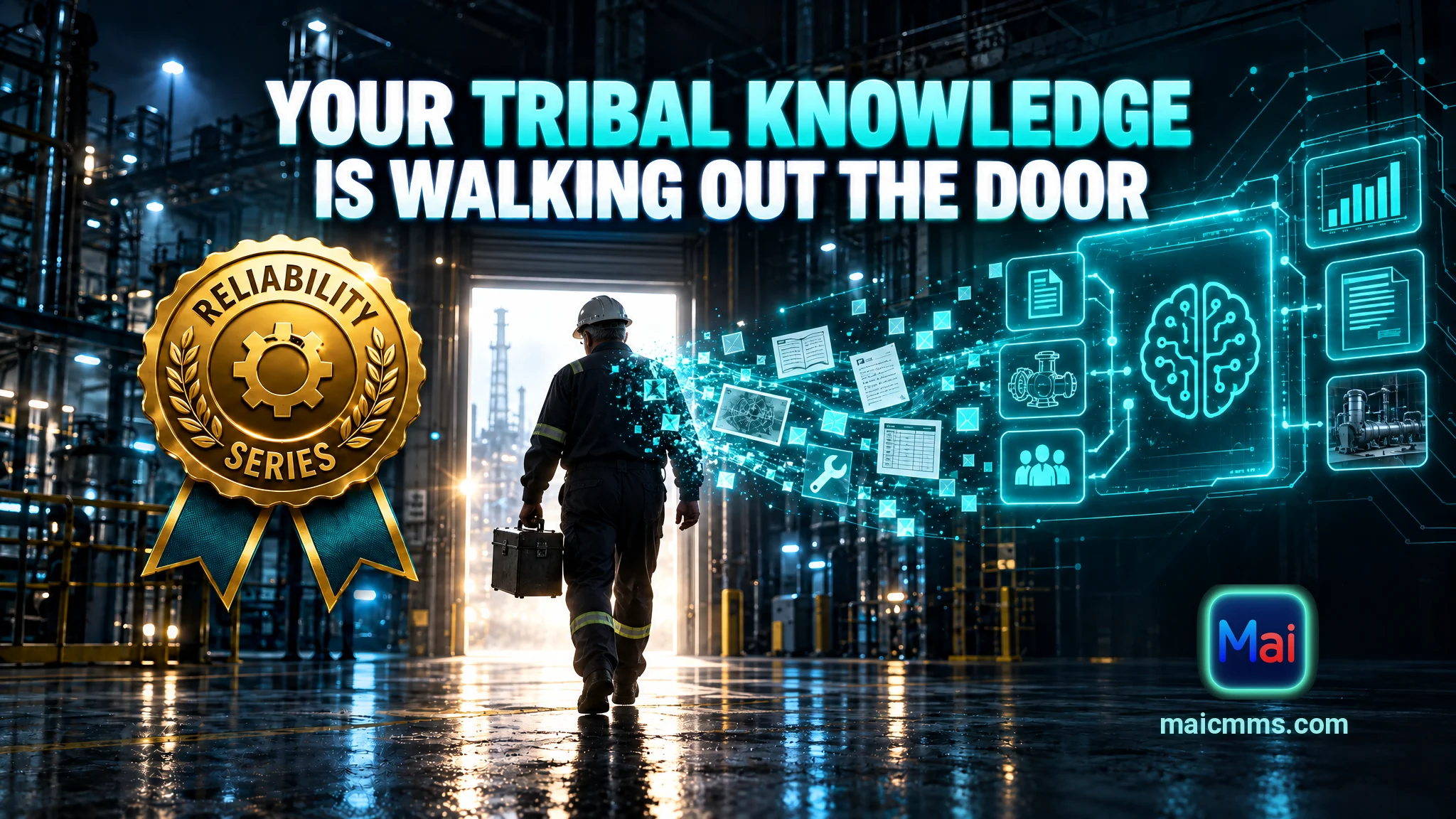
AI Knowledge Bases and Why Your Tribal Knowledge Is Still Walking Out the Door
Every plant has technicians who can diagnose a troublesome asset in minutes because they have seen the failure before. Modern CMMS platforms with AI-assisted knowledge bases change the economics of capture and retrieval.
“The highest-value entries are the ones a technician would text to a coworker.”
Every plant has technicians who can diagnose a troublesome asset in minutes because they have seen the failure before. They know the odd workaround, the part that always fails first, and the photo they took last time that showed the real problem. When those technicians leave, retire, or simply move to another shift, that knowledge leaves with them. The next person starts from zero, repeats the same diagnostic steps, and often makes the same mistakes.
Most organizations try to capture this knowledge with shared drives, binders, or long procedure documents that no one opens. The information exists somewhere, but it is not tied to the asset, not easy to search in the moment, and not updated when the job is done. Modern CMMS platforms with AI-assisted knowledge bases change the economics of capture and retrieval, but only if the content going into them is practical and the habit of using them is built deliberately.
What Actually Needs to Be Captured
Not everything belongs in a knowledge base. Focus on the information that prevents the next person from starting over:
- Short technician notes that explain what was found and why, not just what was replaced.
- Photos of the failed component, the unusual condition, or the correct reassembly.
- One-page job aids or checklists for recurring tasks that have tricks or sequence dependencies.
- Known failure patterns and the quick checks that confirm them.
- Parts that commonly fail together or the specific workaround that avoids a longer repair.
Skip generic theory and lengthy manuals. The highest-value entries are the ones a technician would text to a coworker.
Make Capture Part of the Work Order, Not a Separate Task
The moment of highest knowledge is when the job is being closed. Require a brief note and at least one photo on reactive work orders for critical or repeat assets. Most mobile CMMS apps already support this with a single tap. When the note and photo are attached to the work order and the asset, they become searchable history instead of a forgotten text message.
For procedures, start with the tasks that generate the most calls for help. Have the experienced technician perform the job once while someone captures the key steps and photos, then store the result as a linked document on the asset record. Update it only when the job reveals a better method.
How to Make the Knowledge Base Something People Search
A knowledge base that requires extra logins or returns irrelevant results will be ignored. Tie search directly to the asset or the work order so a technician looking at a pump can immediately see prior notes, photos, and procedures for that asset. AI features help when they surface the most relevant past work orders, but the underlying content still has to be there.
Build the habit in the first 30–60 days: pull up a recent note in huddles instead of asking who remembers, ask technicians to add the one-sentence explanation and photo before they leave the asset, and recognize useful entries. When technicians discover that searching the asset history gives them the earlier photo or note in seconds, they begin to check it before calling for help.
What critical asset in your plant would benefit most from the last three technicians’ notes and photos being searchable in one place?
Put these habits into practice with Mai CMMS
Structured work orders, photo-friendly mobile close-outs and an AI assistant that turns your maintenance history into answers. Start your free trial today.
Start your free trial